Nutmeg oil and mace oil are often listed side by side on supplier catalogs, and buyers new to Indonesian essential oils sometimes assume they’re interchangeable. They come from the same tree and the same fruit — but they’re genuinely different materials with different aromas and different uses.
One Fruit, Two Separate Oils
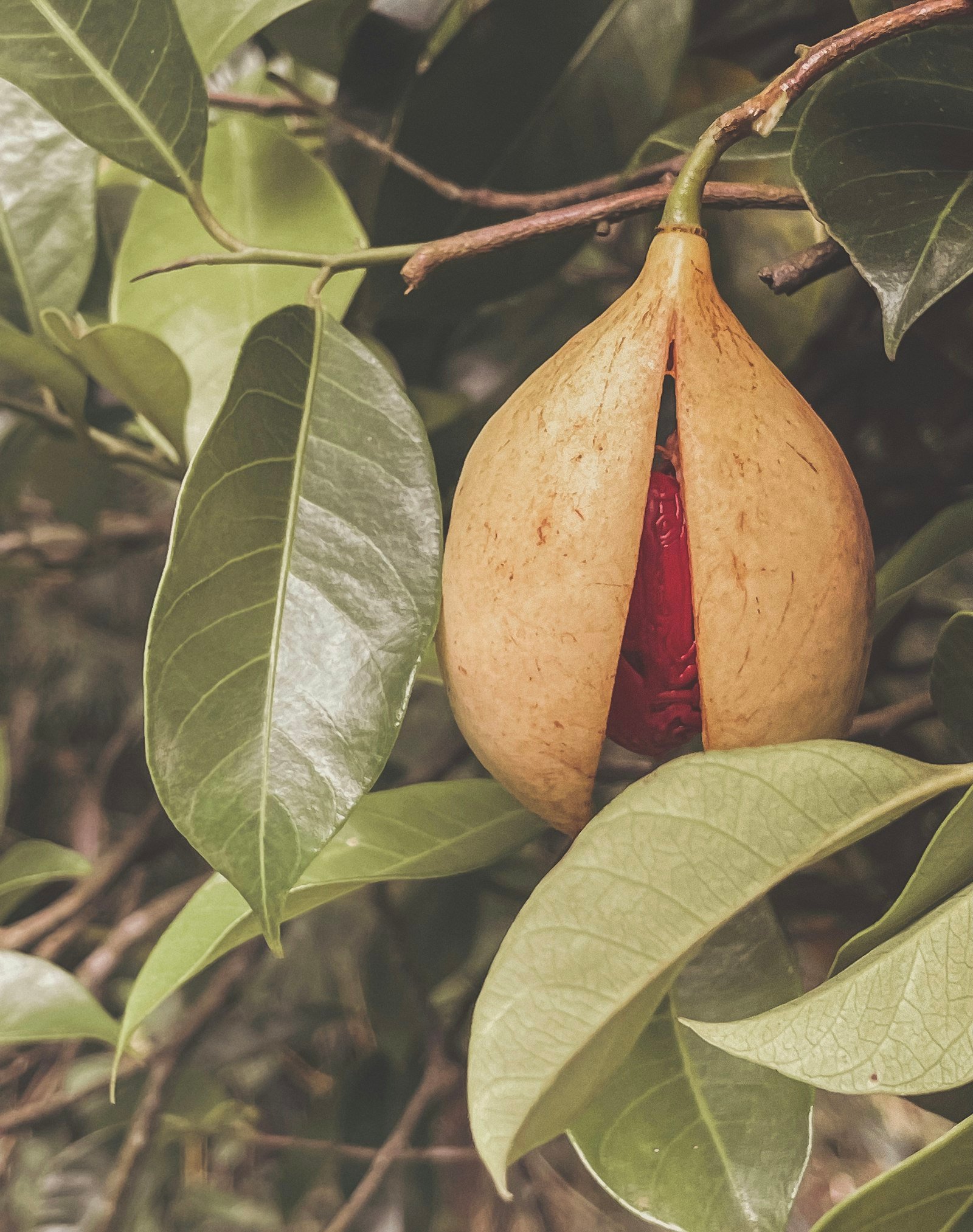
Both oils come from Myristica fragrans, the nutmeg tree native to Indonesia’s Banda Islands and now grown more widely across the archipelago. When the fruit ripens and splits open, it reveals a hard seed (the nutmeg) wrapped in a bright red, lace-like covering (the aril, or mace). Dry and process the seed, and you get nutmeg oil. Dry and process the aril, and you get mace oil. Same tree, two different parts, two different essential oils.
Nutmeg Oil
Nutmeg oil is steam-distilled from the dried seed (kernel). It’s the higher-volume, more widely available of the two, with a warm, spicy-woody profile used across flavor, fragrance, and some pharmaceutical and personal care applications.
Mace Oil
Mace oil comes from the aril surrounding the seed. Because each fruit yields only a thin layer of mace compared to a full seed’s worth of nutmeg, mace oil is produced in much smaller volumes — and typically priced higher as a result. Buyers in fragrance work often describe it as sharper and brighter than nutmeg oil, with less of the heavier, woody undertone.
Choosing Between Them
Neither oil is a direct substitute for the other — they’re complementary rather than interchangeable. If your formulation calls for a classic warm spice note at scale, nutmeg oil is usually the practical choice. If you’re after a lighter, more distinct top note and the lower volume works for your batch size, mace oil is worth sampling.
As with any essential oil, the deciding factor on a specific shipment should be the CoA and GC report for that lot, not the name on the label alone. ESENTARA supplies both nutmeg oil and mace oil in bulk export drums, each with full batch documentation.